
Proposition 51

Official Summary
Authorizes $9 billion in general obligation bonds: $3 billion for new construction, $3 billion for modernization of of K-12 public school facilities, $500 million for charter schools,$500 million for vocational education facilities, $2 billion for Community Colleges facilities.
Fiscal Impact: State costs of about $17.6 billion to pay off both the principal ($9 billion) and interest ($8.6 billion) on the bonds. Payments of about $500 million per year for 35 years.
- Official CA Voter Guide Summary
- Legislative Analyst Office Analysis
- Show Me The Money (as of Oct 22)
- support: $12,000,000
- oppose: $0
- Ballotpedia Summary
Notes
- project monies taken from new 2016 State Schools Facilities Fund and 2016 California Community College Capital Outlay Bond Fund
- appropriates money from the general fund to pay off bonds
- items using Community College money must have average useful life of 10 years, seismic retrofitting given priority
- last state facility bond in 2006; today the state has virtually no remaining funding from previous school/community college bonds
- new construction: state funding 50%, local funding 50%
- modernization projects: state funding 60%, local funding 40%
- modernization projects for charter/tech ed schools: state funding 50%, local funding 50%
Proposition 52
Official Summary
Extends indefinitely an existing statute that imposes fees on hospitals to fund Medi-Cal health care services, care for uninsured patients, and children’s health coverage.
Fiscal Impact: Uncertain fiscal effect, ranging from relatively little impact to annual state General Fund savings of around $1 billion and increased funding for public hospitals in the low hundreds of millions of dollars annually.
- Official CA Voter Guide Summary
- Legislative Analyst Office Analysis
- Show Me The Money (as of Oct 22)
- support: $60,250,000
- oppose: $14,600,000
- Ballotpedia Summary
Notes
- extends current statute indefinitely - Hospital Quality Assurance Fees imposed on hospitals to obtain federal matching funds (since 2009, set to expire 2018)
- 2015-2016 fees = $4.6 B paid by hospitals (used as matching funds for federal funding), $3.7 B paid to hospitals by Medi-Cal, $4.4 B paid to hospitals by federal govt; State General Fund savings $850 M
- Federal government will need to approve extension for hospitals to continue to receive federal funding
- if federal extension does not happen, this fee goes away
- fee could end only by 2/3 vote of ballot proposition measure, not by legislature or simple majority
- Constitutional Amendment portion: fees do not count as revenue toward Prop 98 funding requirement (school funding based on general fund monies brought in)
Proposition 53
Revenue Bonds. Statewide Voter Approval.
"No Blank Checks Initiative"
initiative constitutional amendment
*pending*
Official Summary
Requires statewide voter approval before any revenue bonds can be issued or sold by the state for certain projects if the bond amount exceeds $2 billion.
Fiscal Impact: State and local fiscal effects are unknown and would depend on which projects are affected by the measure and what actions government agencies and voters take in response to the measure's voting requirement.
- Official CA Voter Guide Summary
- Legislative Analyst Office Analysis
- Show Me The Money (as of Oct 22)
- support: $4,800,000
- oppose: $1,750,000
- Ballotpedia Summary
Notes
- Requires statewide voter approval for revenue bond of projects over $2 Billion that are financed, owned, operated or managed by the state (alone or with a partner)
- $2 Billion amount is in current dollars, and would be adjusted for inflation going forward
- Currently,statewide voter 2/3 approval is necessary for all general obligation bonds but not revenue bonds.
- general obligation bonds have lower interest rates than revenue bonds
- Prohibits dividing big projects into pieces under $2 Billion, if they are geographically proximate or dependent on each other
- "project" not defined, and would need claification by the courts
- Applies to revenue bonds
- Very few projects exceed $2 Billion. Possible future projects: WaterFix project to move water through Sacramento-San Joaquin River Delta and California High-Speed Rail project (this is mentioned multiple times as an example by those in favor of this proposition, and is in the text of the law) .
Proposition 54
Legislature. Legislation and Proceedings.
"California Legislature Transparency Act"
initiative constitutional amendment & statute
*PASSED*
Official Summary
Prohibits Legislature from passing any bill unless published on Internet for 72 hours before vote, except in the case of an emergency. Requires Legislature to record its proceedings and post on Internet. Authorizes use of recordings.
Fiscal Impact: One-time costs of $1 million to $2 million and ongoing costs of about $1 million annually to record legislative meetings and make videos of those meetings available on the Internet.
- Official CA Voter Guide Summary
- Legislative Analyst Office Analysis
- Show Me The Money (as of Oct 22)
- support: $10,700,000
- oppose: $27,000
- Ballotpedia Summary
Notes
- authorizes any person to record legislative proceedings by audio or video, except closed session proceedings
- allows recordings to be used for any "legitimate" purpose without payment of any fees to state
- requires that the Legislature records all meetings (except closed sessions) and have those recordings available on the internet within 24 hours, downloadable for 20 years
- Exemption for "emergency": Governor has declared a state of emergency, and 2/3 of house votes to pass the bill faster than 72 hour waiting period allows
- State Constitution currently requires meetings that are not closed-door of Legislature to be open to the public; live videos of most of these meetings are available on the internet, archived and available for use.
- Currently, these recordings cannot be used for political or commercial purposes.
Proposition 55
Tax Extension to Fund Education and Healthcare.
"California Children's Education snd Health Care Protection Act of 2016"
initiative constitutional amendment
*PASSED*
Official Summary
Extends by twelve years the temporary personal income tax increases enacted in 2012 on earnings over $250,000, with revenues allocated to K–12 schools, California Community Colleges, and, in certain years, healthcare.
Fiscal Impact: Increased state revenues—$4 billion to $9 billion annually from 2019–2030—depending on economy and stock market. Increased funding for schools, community colleges, health care for low–income people, budget reserves, and debt payments.
- Official CA Voter Guide Summary
- Legislative Analyst Office Analysis
- Show Me The Money (as of Oct 22)
- support: $56,750,000
- oppose: $3,000
- Ballotpedia Summary
Notes
- extends Prop 30 tax increase on taxable income for singles over $263k, joint over $526k, HOH over $340k:
- extra 1% for $263k-$316k(s), $526k-$632k(j)
- extra 2% for $316k-$526k(s), $632k-$1,053k(j)
- extra 3% for over $526k(s), $1,053k(j)
- original hike enacted in 2012, set to expire 2018, this extends it through 2030
- affects approx 1.5% of taxpayers
- Allocates revenues: 89% K-12 schools, 11% California Community Colleges
- funding for health care up to $2 Billion, depending on whether general fund revenues exceed education spending plus cost of government programs in place on Jan 1, 2016. If so, 50% of the excess (up to $2 B) would go to Medi-Cal. The rest would go to budget reserves, debt payment and programs enacted since Jan 1, 2016.
- Prop 30 sales tax hike of .25% will expire at the end of 2016
Proposition 56
Cigarette Tax to Fund Healthcare, Tobacco Use Prevention, Research, and Law Enforcement.
"California Healthcare, Research and Prevention Tobacco Tax Act of 2016"
initiative constitutional amendment & statute
*PASSED*
Official Summary
Increases cigarette tax by $2.00 per pack, with equivalent increase on other tobacco products and electronic cigarettes containing nicotine.
Fiscal Impact: Additional net state revenue of $1 billion to $1.4 billion in 2017–18, with potentially lower revenues in future years. Revenues would be used primarily to augment spending on health care for low–income Californians.
- Official CA Voter Guide Summary
- Legislative Analyst Office Analysis
- Show Me The Money (as of Oct 22)
- support: $29,800,000
- oppose: $66,300,000
- Ballotpedia Summary
Notes
- tax on cigarettes, tobacco products (cigars, chewing tobacco, products containing at least 50% tobacco) and e-cigarettes (battery operated devices that turn liquid that may contain nicotine into a vapor)
- tax is actually paid to the Board of Equalization by the distributor, to receive the CA tobacco tax stamp, and they pass the cost on to the consumer
- current CA cigarette tax is 87 cents/pack cigarettes, equivalent to $1.37 for other tobacco products; national average is $1.60
- current federal tax on cigarettes is $1.01/pack
- plus sales tax (7.5%-10%)
- average cost $6/pack
- in 2013, 12% of CA adults smoke cigarettes, 4% e-cigarette users
- adds e-cigarettes in definition of "other tobacco products"
- also adds excise tax on distributors of $0.10 for each cigarette, $2.50 for products with '25' CA cigarette stamp, $2 for '20', $1 for '10' (including inventory on the first day of the quarter after this is enacted)
- use of funds:
- replace revenues lost due to lower tobacco consumption (1988's Prop 99, 1998's Prop 10, state and local sales tax decreases)
- 5% max - cost to administer the tax
- $30 M - law enforcement of tobacco-related laws
- $6 M - board to enforcetobacco-related laws
- $6 M - DPH for tobacco-related law enforcement support
- $6 M - Attorney General for tobacco-related law enforcement
- $40 M - UC physician training
- $30 M - DPH dental disease prevention education
- $400 k - adit of agencies receiving funds
- 82% of remaining - Medi-Cal
- 11% of remaining - California Tobacco Control Program - DPH - tobacco prevention and control programs
- 5% of remaining - UC tobacco related disease research
- 2% of remaining - school programs to prevent and reduce use of tobacco products by young people
- exempt from Prop 98 education funding requirement

Proposition 57
Criminal Sentences. Parole, Juvenile Criminal Proceedings and Sentencing.
"Public Safety and Rehabilitation Act of 2016"
initiative constitutional amendment & statute
*PASSED*
Official Summary
Allows parole consideration for nonviolent felons. Authorizes sentence credits for rehabilitation, good behavior, and education. Provides juvenile court judge decides whether juvenile 14 yrs or older will be prosecuted as adult.
Fiscal Impact: Net state savings likely in the tens of millions of dollars annually, depending on implementation. Net county costs of likely a few million dollars annually
- Official CA Voter Guide Summary
- Legislative Analyst Office Analysis
- Show Me The Money (as of Oct 22)
- support: $11,425,000
- oppose: $600,000
- Ballotpedia Summary
Notes
- as of June 2016, there are 128,000 people in state prison
- individuals are often convicted of a primary offense plus additional lesser crimes at the same time
- many individuals with determinate sentences (fixed prison sentence, like '10 years' and not, for example, '25 to life') are eligible for parole hearings after serving half their sentence
- juvenile offenders usually have indeterminate sentences
- juveniles can be sent to adult court in these cases:
- seriousness of crime (murder, specific sex offenses)
- at discretion of prosecutor based on criminal history
- at discretion of judge based on hearing
- in 2015, less than 600 youths were sent to adult court
- counties pay for juvenile incarceration in general (just a portion for juvenile state facilities)
- proposal details
- allows parole consideration for persons convicted of nonviolent felonies upon completion of prison term for their primary offense
- as of Sept 2015 approx 30,000 individuals would be affected
- estimated at approx 7,500 each year
- currently serve 2 yrs before parole eligibility, change would make that timeframe 1.5 yrs
- requires Dept of Corrections & Rehabilitation (DOCR) to adopt regulations to implement new parole and sentence credit provisions and certify that they enhance public safety
- requires that youths 14 yrs and over first be given a hearing at juvenile court, not popped up to adult court automatically based on crime or history
- limits transfer of youths to adult court based on significant crime (murder, robbery, certain sex offenses) when 14 or 15, or a felony when 16 or 17
- allows parole consideration for persons convicted of nonviolent felonies upon completion of prison term for their primary offense
- near term, parole expenses would go up
Proposition 58
Official Summary
Preserves requirement that public schools ensure students obtain English language proficiency. Requires school districts to solicit parent/community input in developing language acquisition programs. Requires instruction to ensure English acquisition as rapidly and effectively as possible. Authorizes school districts to establish dual–language immersion programs for both native and non–native English speakers.
Fiscal Impact: No notable fiscal effect on school districts or state government.
- Official CA Voter Guide Summary
- Legislative Analyst Office Analysis
- Show Me The Money (as of Oct 22)
- support: $4,200,000
- oppose: $0
- Ballotpedia Summary
Notes
- requires that school districts provide English learner students the option to be taught nearly all in English
- schools would no longer be required to teach English learners in English-only programs
- schools would be required to offer intensive English instruction to English learners if parents of 20 or more students in a grade requested it, or 30 or more overall ask for a specific kind of English learner program
- school districts and county offices are required to ask parents andf community members how English should be taught in annual planning process
- makes starting or expanding a bilingual program easier
- changes to Education Code can be made by simple majority instead of 2/3 vote
- about 22% of California students is an English learner (2.7 million) - speak a language other than English at home
- 1998's Prop 227 restricts bilingual programs, requires English learners be taught in English - 1 yr of intensive English instruction and bilingual classes before transitioning to English only classes
- bilingual classes can only happen if 20 students in a grade get waivers, received by fulfilling one of the 3:
- students have attended an English-only classroom for 30+ days and school admin decide bilingual would be better for them
- at least 10 yrs old
- fluent English speakers
- before Prop 227, 30% of English learners were in bilingual programs, 2008 was at 5%
Proposition 59
Corporations. Political Spending. Federal Constitutional Protections.
*PASSED*
Official Summary
Asks whether California's elected officials should use their authority to propose and ratify an amendment to the federal Constitution overturning the United States Supreme Court decision in Citizens United v. Federal Election Commission. Citizens United ruled that laws placing certain limits on political spending by corporations and unions are unconstitutional.
Fiscal Impact: No direct fiscal effect on state or local governments.
- Official CA Voter Guide Summary
- Legislative Analyst Office Analysis
- Show Me The Money (as of Oct 22)
- support: $235,000
- oppose: $0
- Ballotpedia Summary
Notes
- non binding
- reverse the effects of Citizens United
- allow regulation and limitastion of political campaign spending
- ensure individuals are able to express political views
- make clear that corporations should not have the same constitutional rights as human beings
- asks California legislature to propose US Constitutional amendment
- Citizens United v Federal Election Commission ruled that laws placing certain limits on political spending by corporations and unions are unconstitutional
- unlimited independent expenditures can be made by corporations or unions
Proposition 60
Adult Films, Condoms, Health Requirements.
"California Safer Sex in the Adult Film Industry Act"
*Failed*
Official Summary
Requires adult film performers to use condoms during filming of sexual intercourse. Requires producers to pay for performer vaccinations, testing, and medical examinations. Requires producers to post condom requirement at film sites.
Fiscal Impact: Likely reduction of state and local tax revenues of several million dollars annually. Increased state spending that could exceed $1 million annually on regulation, partially offset by new fees.
- Official CA Voter Guide Summary
- Legislative Analyst Office Analysis
- Show Me The Money (as of Oct 22)
- support: $4,600,000
- oppose: $450,000
- Ballotpedia Summary
Notes
- requires adult film producers to obtain state health license (fee of $100, 2 year period) and provide training
- if no license, penalty of $25/day first time, $50/day repeat violation
- imposes liability on producers for violations, on certain distributors, on performers if they have a financial interest in the film involved, and on talent agents who knowingly refer performers to noncomplying producers
- financial penalties: up to $50,000 plus attorney fees to performer with no financial interest if producers did not comply
- permits state, performers, or any state resident to enforce violations, and if Cal/OSHA does not respond in specific timeframe, that person could bring a civil action against film producer
- if they win the suit, they receive compensation for legal fees and 25% of the penalties, with state receiving 75%
- $1000-$7000 if didn't post all the required info first time, $7000-$15,000 for repeat violation
- $70,000 by producer if they knowingly make a false statement
- and more...
- Cal/OSHA time from reported violation to completed investigation expanded from 6 months to a year
- within 10 days of beginning of filming, the following must be posted: address(es) of filming, dates of filming, producer contact info, custodian of records contact info, talent agent contact info, certification that condoms are being used, STI tests have been offered
- Cal/OSHA already requires employers to provide,and ensure that their employees use protective equipment to prevent contact with certain bodily fluids in the workplace, specifically use condoms during sex on adult film sets
- in 2014-2015, 4 production companies were cited for violation of condom regulation
Proposition 61
State Prescription Drug Purchases. Pricing Standards.
"California Drug Price Relief Act"
*Failed*
Official Summary
Prohibits state from buying any prescription drug from a drug manufacturer at price over lowest price paid for the drug by United States Department of Veterans Affairs. Exempts managed care programs funded through Medi–Cal (75% of enrollees).
Fiscal Impact: Potential for state savings of an unknown amount depending on (1) how the measure's implementation challenges are addressed and (2) the responses of drug manufacturers regarding the provision and pricing of their drugs.
- Official CA Voter Guide Summary
- Legislative Analyst Office Analysis
- Show Me The Money (as of Oct 22)
- support: $ 14,480,000
- oppose: $109,000,000
- Ballotpedia Summary
Notes
- applies to any program where the state agency is the ultimate payer for a prescription drug, even if the state agency does not itself by the drug
- state pays for prescription drugs through: Medi-Cal, Public Employees Retirement System, University of California, Dept of Corrections, Public Health (underinsured HIV -positive individuals), State Hospitals, Developmental Services (developmental center residents), California State University
- VA maintains a public database that lists prices paid for most drugs, but some are not listed, pursuant to confidentiality agreements with drug manufacturers
- Drug expenditures in state programs for 2014-2015: $3.8 Billion, of which the State pays about half
- Nationally, prescription drug spending increased 800% between 1990 and 2013
- to be implemented by July 1, 2017

Proposition 62
Official Summary
Repeals death penalty and replaces it with life imprisonment without possibility of parole. Applies retroactively to existing death sentences. Increases the portion of life inmates' wages that may be applied to victim restitution (from 50% to 60%).
Fiscal Impact: Net ongoing reduction in state and county criminal justice costs of around $150 million annually within a few years, although the impact could vary by tens of millions of dollars depending on various factors.
- Official CA Voter Guide Summary
- Legislative Analyst Office Analysis
- Show Me The Money (as of Oct 22)
- support: $9,000,000
- oppose: $10,500,000
- Ballotpedia Summary
Notes
- persons found guilty of first degree murder and sentenced to life without possibility of parole must work while in prison as prescribed by DOCR (Dept of Corrections and Rehabilitation); currently cannot work due to security restrictions
- since 1978, 930 individuals in CA have received a death sentence (in recent years an average of 20/yr), 15 have been executed (none since 2006), 103 died before execution, 64 had sentences reduced, 748 in prison now
- current death sentences are automatically appealed
- the state currently spends $55 Million annually on legal challenges for death sentences
- Related: Proposition 66 changes procedures in Death Penalty cases
Proposition 63
Official Summary
Requires background check and Department of Justice authorization to purchase ammunition. Prohibits possession of large–capacity ammunition magazines (>10 rounds), and requires their disposal. Establishes procedures for enforcing laws prohibiting firearm possession by specified persons. Requires Department of Justice's participation in federal National Instant Criminal Background Check System (currently optional).
Fiscal Impact: Increased state and local court and law enforcement costs, potentially in the tens of millions of dollars annually, related to a new court process for removing firearms from prohibited persons after they are convicted.
- Official CA Voter Guide Summary
- Legislative Analyst Office Analysis
- Show Me The Money (as of Oct 22)
- support: $5,000,000
- oppose: $ 740,000
- Ballotpedia Summary
Notes
- requires most ammunition sales be made through licensed ammunition vendors and reported to Dept of Justice
- 1 year license
- not required if hunter selling less than 50 rounds per month to another licensed hunter on hunting trip
- firearm dealers will automatically get ammunition license
- dealers must report any theft within 48 hours
- vendor who fails to comply 3 times will have license permanently revoked
- starting Jan 2018, most ammo sales must take place through licensed ammo dealer (including internet sales)
- starting July 2019, CA residents bringing ammo into state must have ammo delivered to a dealer (1.5 yrs before current law goes into effect)
- if transaction between 2 non-licensed individuals, must go to licensed dealer to do check before transfer happens, unless immediate family member
- requires specific signage at licensee
- gun show sales are included
- report of sales (current process for handgun ammo) adjusted - removes requirement for right thumbprint on form; must keep ammo sales records - Ammunition Purchase Records File
- Dept of Justice approval to buy ammo
- starting July 2019, dealer will need to check with DOJ to be sure person buying is not on prohibited list
- check not necessary for people with conceal carry permits (July 2016 law negates this)
- individuals must obtain a 4-year permit from Dept of Justice (up to $50 fee)
- large capacity magazines (hold more than 10 rounds)
- have not been sold in CA since 2000
- persons who owned them before 2000 could keep them
- beginning July 2017, these magazines would be illegal
- exempt: if firearm only can use large capacity magazine
- exempt: current and retired law enforcement, armored car businesses, licensed collector of firearms
- in quite a bit of the law's changes, "handgun ammo" is being replaced by "ammo"
- requires lost or stolen firearms and ammunition be reported to law enforcement within 5 days, except antique firearms and for law enforcement individuals
- name, date of birth, physical description
- requires Dept of Justice to provide information about prohibited persons to federal National Instant Criminal Background Check System (NICS) - currently optional
- taking guns away
- new court process to have certain offenders define a designee who will turn over their guns to local law enforcement for holding for 30 days, sell them or give them to a licensed firearms dealer for storage
- prohibited persons:
- convicted of felonies and some misdemeanors (such as assault, battery)
- court determines they are a danger to themselves or others due to mental illness
- with a restraining order against them
- CA Dept of Justice maintains a database of individuals who have legally bought or registered a firearm with the state
- Under federal law, firearm dealers must already do background checks on individuals seeking to buy firearms
- Current Law - 10 day waiting period when buying gun from dealer
- Fines defined in laws, lots of them, mostly $100-$1000
Proposition 64
Marijuana Legalization.
"Control, Regulate and Tax Adult Use of Marijuana Act"
*PASSED*
Official Summary
Legalizes marijuana under state law, for use by adults 21 or older. Imposes state taxes of 15% on sales and taxes of $9.25/oz flowers or $2.75/oz leaves on cultivation. Provides for industry licensing and establishes standards for marijuana products. Allows local regulation and taxation.
Fiscal Impact: Additional tax revenues ranging from high hundreds of millions of dollars to over $1 billion annually, mostly dedicated to specific purposes. Reduced criminal justice costs of tens of millions of dollars annually.
- Official CA Voter Guide Summary (law text is 32 pages!)
- Legislative Analyst Office Analysis
- Show Me The Money (as of Oct 22)
- support: $19,800,000
- oppose: $ 1,600,000
- Ballotpedia Summary
Notes
- taxes
- on growing: $9.25/oz flowers or $2.75/oz leaves
- retail tax: 15%
- existing state and local sales tax (currently 7.5%-10%) - only on non-medical
- funds deposited into California Marijuana Tax Fund
- legal to:
- possess up to 28.5 grams of marijuana
- possess up to 8 grams of concentrated cannabis
- possess up to 6 plants in a private residence, and the marijuana produced by them (in locked space, not visible from public space)
- allows for local regulation/taxes/prohibition
- authorizes resentencing and destruction of records (within 2 years) for prior marijuana convictions
- mandatory labeling and packaging requirements
- large scale cultivation licenses prohibited for the first 5 years; license could be denied if the grower could "allow unreasonable restraints on competition by creation or maintenance of unlawful monopoly power"
- mandates that products cannot be advertised or marketed towards children
- allows industrial hemp to be grown, regulated separately from cannabis with higher delta-9 THC concentrations
- prohibited:
- smoking in public spaces
- smoking where tobacco smoking is prohibited
- smoking or ingesting within 1000 feet of K-12 school, day care center or youth center when children are present except upon grounds of private residence if smoke is not detectable on those grounds
- no open containers in vehicles
- penalties: drug education programs + community service for those under 18, fines up to $250
- licenses will start to be distributed in 2018; until 2020, must have been continuous California residency since Jan 1, 2015; until 2020, priority given to existing medical marijuana vendors; not to violent/serious/embezzlement/fraud/drug activities with a minor/drug trafficking felons or persons previously convicted of illegal marijuana activities within 3 years
- patients with current medical marijuana permit will have to be re-certified by 2018 (fee up to $100)
- under federal law, it is illegal to posses or use marijuana, but US DOJ chooses not to prosecute most marijuana users and businesses that follow state and local law
- 1996 Prop 215 legalized medical marijuana in CA
- regulated by the Bureau of Marijuana Control - handles both medical and non-medical regulations and licensing; edibles and testing regulated byDept of Public Health; growers also regulated by Dept of Food and Agriculture, State Water Resources Control Board, Dept of Fish and Wildlife, Dept of Pesticide Regulation
- purchase would occur at state-licensed business (not within 600 feet of a K-12 school, day care or youth center) or through their delivery service
- state-licensed business could not sell alcohol or tobacco products, could allow on-site consumption with local authorization
- cultivation applicants must include procedures on the application for: cultivation, extraction and infusion methods, transportation process, inventory process, quality control, water source(s), diagram of premises
- California Marijuana Tax Fund allocations
- $10-50 Million - grants to communities most affected by past drug policies
- $10 Million - evaluate effects of the measure (2018-2028)
- $3 Million - create and adopt methods to determine whether someone is driving while impaired (2018-2022)
- $2 Million - study risks and benefits of medical marijuana
- 60% of remaining - youth programs, including substance use disorder education, prevention and treatment
- 20% of remaining - clean up and prevent environmental damage of illegal growing of marijuana
- 20% of remaining - programs designed to reduce driving under the influence and grant program designed to reduce any potential negative impacts on public health or safety resulting from the measure
Proposition 65
Official Summary
Redirects money collected by grocery and certain other retail stores through mandated sale of carryout bags. Requires stores to deposit bag sale proceeds into a special Wildlife Conservation Board fund to support specified environmental projects.
Fiscal Impact: Potential state revenue of several tens of millions of dollars annually under certain circumstances, with the monies used to support certain environmental programs.
- Official CA Voter Guide Summary
- Legislative Analyst Office Analysis
- Show Me The Money (as of Oct 22)
- support: $6,100,000
- oppose: $0
- Ballotpedia Summary
Notes
- law was passed (SB 270) in 2014 requiring stores to charge at least 10 cents for carryout bags, and stores keep those monies. If this referendum passes it will go into effect, if not it will be repealed.
- funds from minimum charge for single use bags would now go into the Environmental Protection ad Enhancement Fund instead of being kept by retailers
- relevant for stores with gross annual sales of over $2 Million of groceries, is over 10,000 sf including pharmacy or is a convenience store that has a liquor license
- Environmental Protection ad Enhancement Fund grants for:
- drought mitigation
- recycling
- clean drinking water supplies
- state, regional and local parks
- beach cleanup
- litter removal
- wildlife habitat restoration
- max 2% admin fees
- $400k for annual audit
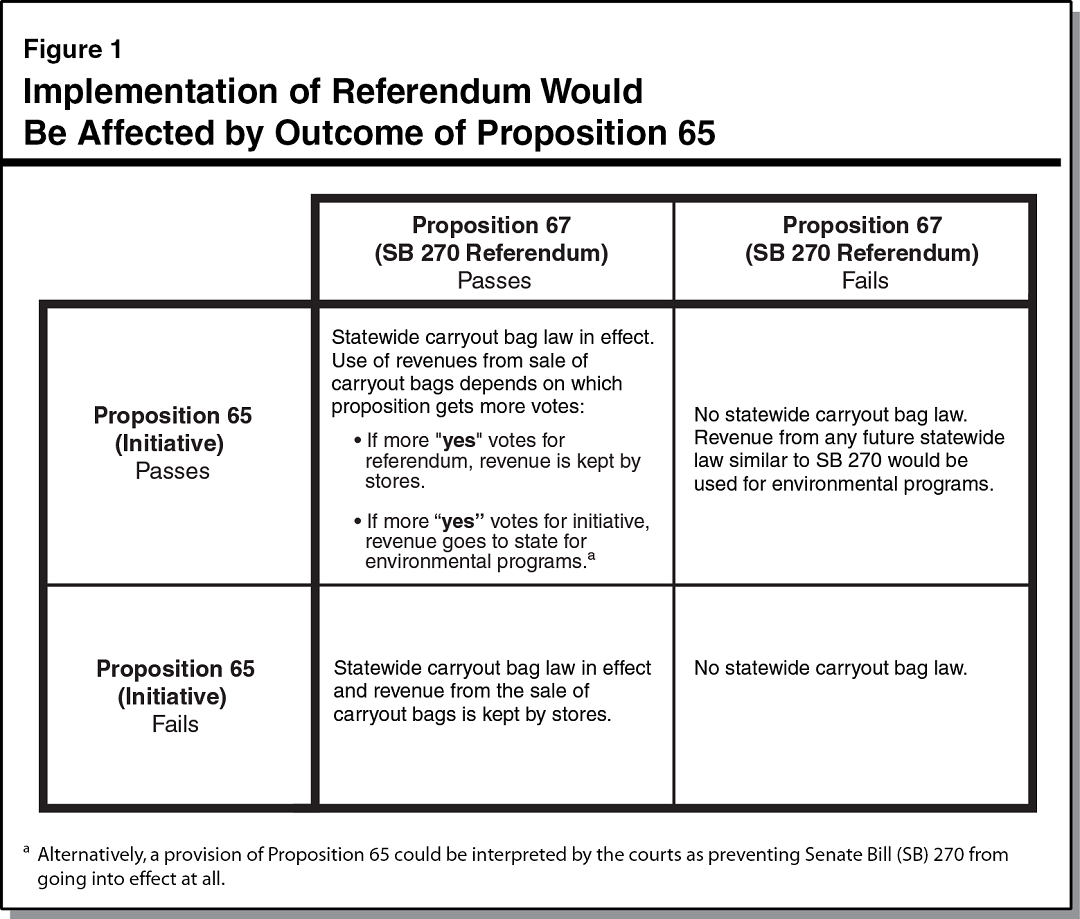
- Proposition 67 also concerns single use bags. Here's what would happen if each passes/fails.


Proposition 66
Official Summary
Changes procedures governing state court challenges to death sentences. Designates superior court for initial petitions and limits successive petitions. Requires appointed attorneys who take noncapital appeals to accept death penalty appeals. Exempts prison officials from existing regulation process for developing execution methods.
Fiscal Impact: Unknown ongoing impact on state court costs for processing legal challenges to death sentences. Potential prison savings in the tens of millions of dollars annually.
- Official CA Voter Guide Summary
- Legislative Analyst Office Analysis
- Show Me The Money (as of Oct 22)
- support: $12,500,000
- oppose: $10,280,000
- Ballotpedia Summary
Notes
- establishes time frame for state court death penalty review
- total of 5 years max instead of current system when it could take decades
- under current law, death penalty verdicts are immediately appealed ("direct appeal") to California Supreme Court, then they can ask the US Supreme Court to review the case
- many cases also involve Habeas Corpus appeals, in the California Supreme Court and the federal courts
- Habeas Corpus petitions - new
- must be first heard in trial courts by the judge that handeled the original trial, instead of California Supreme Court (within 1 year of original verdict). Next step would be the Court of Appeals (must file within 30 days of trial court appeal verdict), then California Supreme Court
- must be filed within 1 year of attorney appointment, currently about 5 years
- limits to one petition
- Habeas Corpus Resource Center board dissolved, Center put under California Supreme Court, and its attorneys shall be paid the same as public defenders
- Califonia Supreme Court appoints attorneys for inmates that cannot afford them; currently 409 are waiting to get attorneys appointed
- authorizes death row inmate transfers among California prisons
- increases portion of condemned inmates' wages that may be applied to victim restitution (from 50% wages to 70%, including wages and trust account deposits)
- exempts the state's execution procedures from the Administrative Procedures Act, trial court would offer valid method of execution (lethal gas or lethal injection)
- states that other death penalty measures are void if this one receives more votes
- Related: Proposition 62 abolishes the Death Penalty in California , but if this gets more votes, the death penalty stays put
Proposition 67
Official Summary
Prohibits grocery and other stores from providing customers single–use plastic or paper carryout bags but permits sale of recycled paper bags and reusable bags at a minimum of 10 cents per bag.
Fiscal Impact: Relatively small fiscal effects on state and local governments, including a minor increase in state administrative costs and possible minor local government savings from reduced litter and waste management costs.
- Official CA Voter Guide Summary
- Legislative Analyst Office Analysis
- Show Me The Money (as of Oct 22)
- support: $2,000,000
- oppose: $6,000,000
- Ballotpedia Summary
Notes
- currently 40% of California's population lives in areas where single use bags are banned, normally requiring stores to charge at least 10 cents, which the store keeps
- law was passed (SB 270) in 2014 requiring stores to charge at least 10 cents for carryout bags, and stores keep those monies. If this referendum passes it will go into effect, if not it will be repealed.
- this measure creates new standards for durability of carryout bags
- design: handle good for 125 uses; volume of 15 liters; can carry 22 lbs for min 175 feet; for plastic at least 2.25 mils thick; for fabric at least 80 grams per square meter and sewn
- has label
- able to be cleaned
- recyclable
- does not contain toxic material
- made of post-consumer recycled material min 20% before 2020, 40% after
- special section for compostable bags
- reusable grocery bag producer list maintained
- producers of recyclable bags must be certified every 2 years
- process for consumers to say eusable bag is not up to snuff
- relevant for stores with gross annual sales of over $2 Million of groceries, is over 10,000 sf including pharmacy or is a convenience store that has a liquor license
- customers using WICS don't have to pay for single use bags
- monies collected by stores for single use bags must be used for cost of those bags, complying with regulation and educational materials encouraging use of recyclable bags
- penalty for noncompliance, starting at $1000/day, up to $5000/day
- states that no other laws on single use bags can be implemented or enforced
- provides for loans to producers of reusable bags
- Proposition 65 also concerns single use bags. Here's what would happen if each passes/fails.

Definition : Initiative Constitutional Amendment
Definition: The ballot initiative process gives California citizens a way to propose California state constitutional amendments without the support of the Governor or the Legislature.

Definition : Initiative Statute
Definition: The ballot initiative process gives California citizens a way to propose laws without the support of the Governor or the Legislature.
More info: CA Attorney General site

Definition : Legislative Advisory Question
Definition: Voters would be asking their elected officials to use their constitutional authority in a certain way. Non binding.